
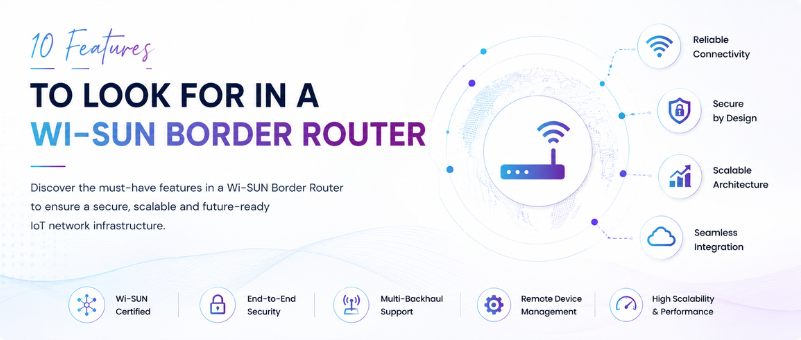
If an IoT network is the nervous system of a smart city or utility grid, a Wi-SUN Border Router is basically the brainstem in that system, silently doing the heavy lifting that keeps the Wi-SUN network stable, scalable and secure. Whether you are developing smart metering, street lighting, automation of distribution, or an industrial IoT using Wi-SUN technology, the selection of a suitable border router can make or break your entire deployment process across a Wi-SUN mesh environment.
Why the Wi-SUN Border Router Matters?
A Wi-SUN Border Router is used to bridge your Wi-SUN mesh network (Field Area Network) to your backhaul network (Ethernet / LTE / Fibre) and then to your cloud, head-end system or SCADA in a large-scale Wi-SUN network. It's responsible for:
- Routing stability & Wi-SUN mesh network formation.
- Reliable packet forwarding across the Wi-SUN network
- Security enforcement within Wi-SUN technology deployments
- Monitoring + diagnostics of the Wi-SUN mesh
- Scalability with an increase in nodes across the AaensaTech Wi-SUN network.
In simple terms, it is not a mere gateway; it is the centre of control of your Wi-SUN network. So, here is the real deal: the 10 most crucial features to look for when buying a Wi-SUN Border Router for Wi-SUN technology - based deployments.
Top 10 Features to Look for in a Wi-SUN Border Router
1) Strong Mesh Network Performance (Routing + Reliability)
A Wi-SUN border router must be intelligent in managing Wi-SUN mesh behaviour, particularly in the outdoor use cases, where signal variation and interference are highly practical in any Wi-SUN network.
What to check:
- Dynamic routing stability within the Wi-SUN mesh
- Reliability in packet delivery across the Wi-SUN network
- Network healing and rerouting schemes using Wi-SUN technology
- Low retransmission overhead and latency
Why it matters: Smart city Wi-SUN networks do not allow second chances. When packets are lost, operations are adversely affected.
2) Sophisticated Security (Utility-Grade Protection)
Wi-SUN networks are deployed in critical infrastructure environments, making security a core requirement in Wi-SUN technology. Your border router must secure the entire Wi-SUN mesh from edge to core.
What to check:
- Strong encryption support for the Wi-SUN network
- Secure device join process within Wi-SUN technology
- Authentication mechanisms for Wi-SUN mesh nodes
- Secure key handling across the AaensaTech Wi-SUN Network
Why it is important: A single vulnerability point will expose the entire Wi-SUN network.
3) Multiple Backhaul (Ethernet + Cellular + More)
Your Wi-SUN mesh network requires a strong bridge to enterprise systems and cloud platforms. A border router must support diverse backhaul options for scalable Wi-SUN technology deployments.
What to check:
- Ethernet support for fixed Wi-SUN network installations
- LTE/4G/5G for remote Wi-SUN mesh locations
- Dual-backhaul redundancy in Wi-SUN technology
- Programmable network controls
Ideal use: Remote utility locations, rural metering, and outdoor Wi-SUN network infrastructure.
4) Remote Monitoring and Diagnostics
Operating a Wi-SUN network without visibility leads to failure. A good border router must offer deep diagnostics for Wi-SUN mesh health.
What to check:
- Live health status of the Wi-SUN network
- Node visibility and performance tracking
- Logs and event reporting across Wi-SUN technology
- Link quality indicators
- Alerts for abnormal Wi-SUN mesh behaviour
Why it is important: It minimises downtime and accelerates Wi-SUN network troubleshooting.
5) Firmware update Support (Secure + Stable)
A border router in a Wi-SUN network must allow secure evolution of Wi-SUN technology without disrupting operations.
What to check:
- Secure firmware update mechanisms
- Rollback capability for Wi-SUN mesh
- Scheduled update windows
- OTA-ready architecture for Wi-SUN network scalability
Why is it important: Long-term Wi-SUN technology deployments require continuous improvement.
6) Edge Intelligence (Local Processing
The inefficiency and risks incurred in sending each packet to the cloud are inefficient and unsafe in modern deployments. Edge processing can be facilitated by border routers to make decisions faster and use less bandwidth.
What to check:
- Local rule engine for Wi-SUN technology
- Event-triggered reporting within the Wi-SUN mesh
- Reduced reliance on cloud connectivity
- Smart buffering & queueing for Wi-SUN networks
Best on: Real-time operations such as outages, alarms or fault detection in Wi-SUN technology deployments.
7) Industrial-Grade Design (Ready for the Outdoors and Harsh Environment)
Wi-SUN installations are usually used outdoors, within an enclosure, on a pole, within a substation, not within an AC room where there is vibe. The border router ought to be constructed like a tank.
What to check:
- Industrial enclosure for Wi-SUN technology
- High uptime reliability in the Wi-SUN mesh
- Wide temperature tolerance
- Surge protection
- Stable performance across the Wi-SUN network
Why it is important: Infrastructure implementations require it to be sustainable, and not lab-only performance.
8) Wi-SUN FAN Compliance/Certification Support
Compliance ensures seamless operation within a certified Wi-SUN network and interoperability across vendors.
What to check:
- Wi-SUN FAN profile support
- Certification-ready design
- Multivendor endpoint interoperability.
Why it is important: Lack of compliance = Shaky deployments and integration difficulties down the line.
9) Network Management and Easy Provisioning
Operational friction is a more frequent cause of deployments showing failure than the technical constraints. Your router must not be complicated with network configurations and onboarding processes.
What to check:
- Basic configuration system.
- Automated support of provisioning.
- Policies of device join control.
- Network segmentation facilities.
Why it is important: The less effort put in, the quicker the rollout, the fewer errors.
10) Scalable Node Capacity (Built for Growth)
This feature can be implemented on a single main node, or multiple secondary nodes can be deployed, each replicating the functionality of the primary node. Given that your router must be capable of managing high node density, performance should not be reduced to a phone with 1% battery.
What to check:
- Maximum supported nodes (in practice, not only in the paper)
- Resourceful routing & memory management.
- Load consistency Performance.
Best for: Smart metering, street lighting, utility-scale networks.
Conclusion
A Wi-SUN Border Router is not just hardware. It is the anchor of your Wi-SUN network. The right router strengthens security, improves scalability, and simplifies long-term operations across Wi-SUN technology deployments.
If you need help selecting a feature-rich border router or planning a large-scale Wi-SUN mesh deployment for smart metering, street lighting, EV infrastructure, or utility automation, AaensaTech Wi-SUN Network solutions are designed to guide you at every step.
Connect with AaensaTech Wi-SUN Network experts for deployment guidance and end-to-end Wi-SUN technology support today.
FAQs
FAQ 1: What does a Wi-SUN Border Router mean?
A Wi-SUN Border Router is the centre of a Wi-SUN mesh network (Field Area Network), and provides a connection between a mesh network and other networks, either Ethernet or cellular networks, which mediate secure communication between the endpoints and other networks, e.g. cloud networks or utility networks.
FAQ 2: What is the significance of a Wi-SUN Border Router in a smart city implementation?
It helps to manage massive external networks by offering a steady routing, securely onboarding, and trustworthy backhaul connection, and centralised surveillance that is essential in the utilisation of smart metering, street lighting, and grid automation.
FAQ 3: What is the maximum number of nodes that the Wi-SUN Border Router can serve?
The capacity of the node is determined by the device design and the conditions of the network. An optimal Wi-SUN Border Router will be able to support a huge number of nodes simultaneously without reducing its performance, even at the peak load of the network.
FAQ 4: What are some of the backhaul options that a Wi-SUN Border Router should consider?
A Wi-SUN Border Router should be capable of Ethernet and cellular capability (LTE/4G/5G). It is advantaged by the fact that it has dual backhaul availability.
FAQ 5: Are Wi-SUN networks more dependable than cellular IoT networks?
Using Wi-SUN is widespread in local area-based large networks since it uses a mesh network that has the capacity to reroute without much ado to improve reliability in cases where some endpoints have signal or coverage issues.